

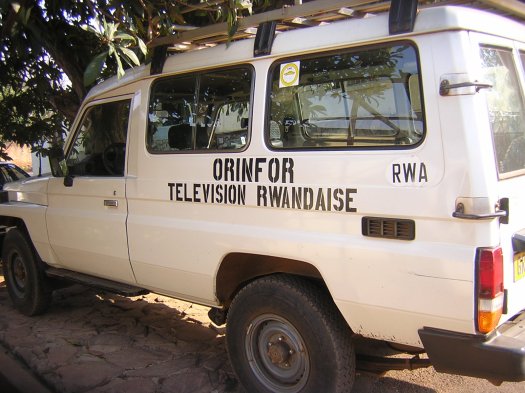
I probably could have written a lot more about the time I spent at RTV. After all, it was the whole point of the trip. It took this long to get to writing anything about work because it took us this long to actually start. At the time, RTV was headed by an American-born Rwandan woman named Kije. It was strange to us there was so much suspicion about allowing a few Canadians (two students and one instructor) to be there. We thought an American would be all for transparency and press freedom. Not so much, it seemed. We eventually did get to work with the journalists and photographers for the station.
 July 27, 2007 –
It was exactly three weeks after I landed in Kigali when I finally had my first day of work at Rwanda Television. We had visited TVR before so we weren’t shocked by the state of the newsroom.
But then I remembered that this is a state-run television station and the only station available in Rwanda. How could the newsroom be like this? It’s one room, very much like your dining room, with a table and some chairs. The newsrooms I’ve visited are usually this simple but at TVR, the reporters don’t have their own cubicles, or even their own desks. They certainly don’t have their own computers. In fact, there’s only one computer, which isn’t used for anything significant other than to type the list of who’s covering what and the line-up for the evening’s newscasts. They did have top-notch editing suites.
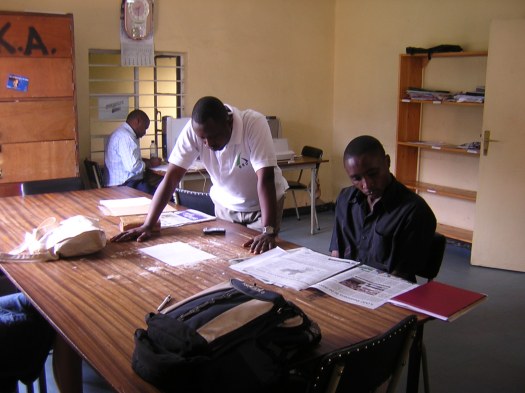
Without computers, the reporters write all their scripts by hand, in three languages. With these scant resources, TVR is still able to broadcast three newscasts, in Kinyarwanda, French and English, every night. They’re not beautiful pieces of work like we see on CBC but I respect them for being able to work with what they have. Like any workplace, it’s the people that will make it memorable. The first day started with small talk about sports with Faruk and meeting everybody with handshakes and introductions.
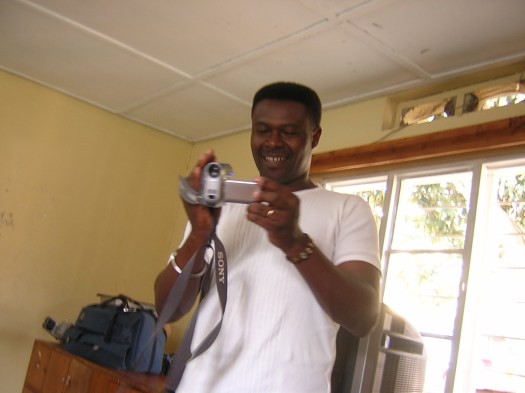 Actually everyday starts with shaking everyone’s hand as per Rwandan custom.
“Do you shake hands where you come from?”a reporter named Frank asked while we were shaking hands. “Yeah,” I replied. “But not every single time we see each other.”
Later in the morning, I went out with Alice to cover an event at a hospital. The whole thing was in Kinyarwanda so I couldn’t follow along. Basically, the Rwanda Revenue Authority was giving the hospital a cheque for 2-million francs to help treat the loads of poor patients who can’t afford it. And I do mean loads. Canadians used to complain about wait times. Canadians don’t know wait times. Women and children crowded the outside of the hospital at the earliest hours of the morning waiting for how long, I don’t know. I doubt if even a quarter of them got the help they needed.
This first day fulfilled my expectations of what life will be like as a journalist. I wanted some way to be out in the world everyday, seeing for myself what’s happening. Seeing what many people wouldn’t get to see in an average day. It’s exactly what I signed up for.
 andrewng.media